
This is an old revision of the document!
Table of Contents
Flint
Flint
| Population: | 800 000 |
|---|---|
| Dirigeant: | Governor Roland Stanfield |
| Quartiers majeurs: |
The Ayres, Bosum Strand,
Central District, the Cloudwood,
the Nettles, North Shore,
Parity Lake,Pine Island, Stray River |
| Lieux importants |
|---|
Cauldron Hill, Parity Lake,
Stanfield Canal. |
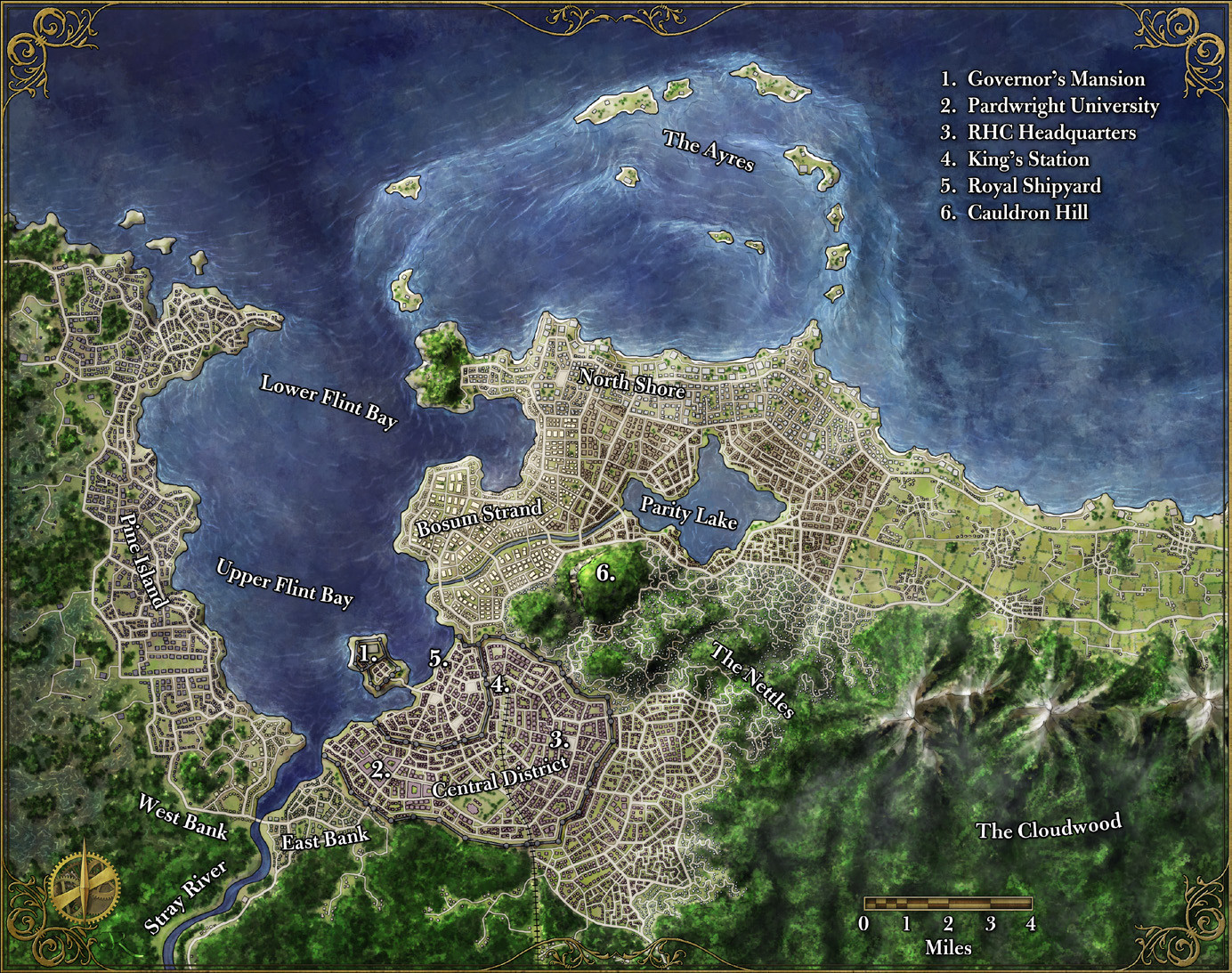
City Districts
Each district has its own mayor who handles local affairs, all of
whom are elected except the mayor of The Nettles, whose additional
role as guardian of the cursed Cauldron Hill requires he be ap-
pointed by the governor and approved by the king.
Districts also elect representatives to the city council, whose
authority is balanced against that of the city governor, Roland
Stanfield. Technically the position of governor is elected, but aside
from brief periods after the deaths of various incarnations, Stan-
field has held the position for over four centuries.
Bosum Strand
Navras Opera House
Flint’s oldest surviving building is the Navras Opera House in the central district. Navras, an eladrin who fled Elfaivar after the Great Malice, designed the opera house and laid the cornerstone with a brick he had brought from his homeland. He spent nearly two hundred years personally overseeing its construction, and was aided by no less than eight Risuri kings. When he completed the building, incongruously huge for what was at the time just a small river fort city, Navras gave the first performance by sing- ing the dirge of Vekesh. As the audience cheered and wept at his performance, he walked off the stage and disappeared forever. The acoustic design of the performance hall somehow captures magical power from song, or from the emotional reactions of the audi- ence. Impresarios who coordinate performance almost always hire spellcasting bards to harness this energy and craft a magic item as a me- mento of the show. In the three hundred years since the Navras Opera House opened, most of these items have found their ways into private collections, but a rare few have become famous, such as the Hurricane Violin, which commemo- rated the Fable of Seaquen and later banished a sea monster that threatened Flint Harbor in 417 a.o.v.
Depending on who you ask, the name Bosum Strand comes either
from the boatswains who frequented its taverns, or from the har-
bor’s more traditional name, which translated to bosom of the sea.
In either case, the docks along the east shore of Flint Bay are the
heart of the city’s trade, culture, and crime.
Hundreds of warehouses serve Flint’s merchant fleet, and doz-
ens of bars, taverns, gambling houses, and brothels serve its dock
workers. Craftsmen, artists, and money changers own shops sur-
rounding several scattered public squares throughout the district,
and the district’s mayor Griffin Stowe has strong-armed property
owners along major streets to ensure that when the wealthy and
influential travel the strand they are not forced to see any of the
district’s uncouth underbelly.
This is why, of course, the dockers make a point to perform on as
many street corners and squares as possible.
The district is currently clearing out tenants and demolishing
buildings for a freight rail line. The station is already under con-
struction, and once complete it will speed delivery of raw materials
and natural exports. More importantly, it will let Flint share its
industrial bounty with the rest of the nation. Unusually, many local
druids have been recruited to speak with the spirits of the land and
appease them so they will not disrupt the building process.
The Night of the Mirror Moon occurs when the High Winter
moon is the fourth full moon of the season. From the moment the
moon shines on Flint Harbor, anyone who enters the water while
holding a mirror will emerge in the Dreaming analogue of Bosum
Strand. There, it is said, the docks are replaced by a glorious beach
where all the fey from miles around gather for the wildest party one
could ever imagine. Sometimes people fail to get back before the
moon sets, while others return with magical powers, a gift or bar-
gain from the fey. The last such Mirror Moon happened seventeen
years ago, in 483 a.o.v., and the next will be in two years.
Central
The oldest and most developed district of Flint is
home to its main government structures, including
the city council, superior court, police headquarters, and the offices of various civil functionaries
like tax collectors. Grand party halls, ornate druidic garden temples, and parks filled with monuments
to old wars provide recreation and entertainment
for the city’s nobility and prospering middle class,
while the Orange Street commodities market and
the prestigious Pardwight University are the dual
hearts of Flint’s economic and academic cultures.
The district mayor Oncala Putnam recently approved construction of a grand subrail station to serve
as the hub of a city-wide transportation network.
Currently the Central district is often clogged
with traffic from the surface rail station, since the
proposed tunnel through Humble Hill in the Nettles,
meant to provide an easier route to the factories
of Parity Lake, has been dogged by sabotage from
elements opposed to the industrialization of Risur.
Just off the coast in Flint Bay, the city governor’s
mansion occupies what was once an island fortress.
For the past 400 years Roland Stanfield has, through
various incarnations and with only rare disruption,
served as city governor, earning near universal
respect for his wisdom and leadership.
Perhaps most importantly for the PCs, Central
district is home to the local headquarters of the
Royal Homeland Constabulary, headed by Lady
Inspectress Margaret Saxby. Extensive details of
the local branch are presented below, in the Royal
Homeland Constabulary section.
Navras Opera House
Flint’s oldest surviving building is the Navras Opera House
in the central district. Navras, an eladrin who fled Elfaivar
after the Great Malice, designed the opera house and laid the
cornerstone with a brick he had brought from his homeland.
He spent nearly two hundred years personally overseeing its
construction, and was aided by no less than eight Risuri kings.
When he completed the building, incongruously huge for what
was at the time just a small river fort city, Navras gave the
first performance by singing the dirge of Vekesh. As the audience
cheered and wept at his performance, he walked off the stage
and disappeared forever.
The acoustic design of the performance hall somehow captures
magical power from song, or from the emotional reactions of
the audience. Impresarios who coordinate performance almost
always hire spellcasting bards to harness this energy and
craft a magic item as a memento of the show. In the three
hundred years since the Navras Opera House opened, most of
these items have found their ways into private collections,
but a rare few have become famous, such as the Hurricane
Violin, which commemorated the Fable of Seaquen and later
banished a sea monster that threatened Flint Harbor in 417 a.o.v.
Subrail Construction
A major freight and passenger railroad line enters from the south and stops at King’s Station, but local light rail routes are being constructed throughout Central District. Most of this route travels underground, thus earning the moniker subrail. One section parallel to the freight line travels aboveground in the same corridor, and a brief stretch of track near Pardwight University rises to the surface by necessity, due to some magi- cal quirks of geography.
Cloudwood
The eastern outskirts of Flint are dominated by towering mountains, their peaks constantly shrouded
in clouds that feed lush rainforests and verdant
streams. The steep highlands are sparsely populated, but numerous plantations and small farms
fill the flatter terrain near the coast. Few city folk
venture out to these lands, believing that here the
veil between the real world and the Dreaming is
thin. Local myths include countless tales of farmers, travelers, and juvenile miscreants who wander
into the foggy woods and suffer wretched fates at
the hands of capricious fey.
While most who live in Cloudwood consider it
common courtesy to share a bowl of milk or plates
of sliced fruit with unseen nightly visitors, the
district’s new mayor, Doyle Idylls, has forbidden district employees from engaging in the old tradition.
Mayor Idylls shares his office with the local police
branch, and he recently had salt baked into bricks
around its base in order to keep away curious fey.
Soon after, the building developed a gopher problem.
Though criminals in Flint tend to make the Nettles their first stop when on the run from the law,
those who really need to lay low find the wild rainforests of Cloudwood ideal. The most rural areas of
the district are practically independent thorps and
hamlets, many of which are sympathetic to desperate outsiders. Until recently they reaped rewards
from collaborating with at least three gangs which
operated out of the forest, but a new player in the
area has somehow managed to get the gangs to call off their attacks.
Somewhere in the high misty mountains hides
Hana “Gale” Soliogn, an eladrin who fled to Risur
after she escaped the rich Danoran family who had
kept her as a trophy for over a century. Upon leaving
the dead magic zone of Danor, Soliogn discovered
an exceedingly rare talent for innately controlling
winds and weather, which earned her the name Gale.
She enjoyed a brief celebrity upon arriving in
Flint a year ago, but almost immediately withdrew
into the wilderness and began recruiting followers
among those opposed to the influx of industry. Law
enforcement officials believe she’s trying to punish
Danor by proxy, and in the past several months
hundreds of acts of sabotage on factories and
steamships have been linked to her. In one incident,
Gale was caught in the act of trying to assassinate a
sleeping industrialist, but she managed to fly away
and avoid capture.
The Nettles
A small spur of the mountains of the Cloudwood
cuts into the heart of Flint, and for most of the
city’s history these hills were home to druidic rituals, or simply let romantics witness wondrous vistas
of the beaches from on high. Their traditional
name came from an old commander of the Flint
fort, who saw them as a thorny barrier against attack from the north.
But then in 346 a.o.v. a coven of witches took residence upon a jagged mountain at the range’s edge,
which ever since has been called Cauldron Hill. For
decades they terrorized the city, sending goblins
and specters to abduct people for sacrificial rites,
then hiding in the veil between this world and the
Bleak Gate whenever any tried to assault them.
Eventually the witches were defeated when King
Lorcan allied with a Crisillyiri godhand and led
an assault during a lunar eclipse. Ever since, the
peak of Cauldron Hill has been rife with haunting and spirit activity, and one of the key tasks of
the district mayor has been to keep daring fools
from ascending the mountain and coming down
possessed.
The greatest achievement of the previous district
mayor was constructing a highway across Humble
Hill to make travel across the city easier, but in
the past few decades the district, even the base of
Cauldron Hill itself, have grown thick with slum
housing, as more and more people flock to Flint
hoping to find work in the factories. The broad
switchbacks of the highway are cluttered with
shacks, often with two or three families sharing
the same building. Poorly crafted houses cling to
the sides of slopes, and they have become a nightmare for local police to patrol, giving a whole new
connotation to the name “The Nettles.”
Current district mayor Reed Macbannin has been unable to
halt the new arrivals, and he hasn’t been helped by the common
prejudice that the factory workers are prone to crime, laziness, and
general mayhem. Despite this, he has managed to earn passing
respect from the people of his district; few are trusted with the
stewardship of Cauldron Hill, and he has leveraged his office to get
city tax money for the poorest of the poor.
North Shore
The sun rises through the mists of Cloudwood, banishing the night
with pale purple clouds dashed by the golden gleam of dawn. Fresh
sea breezes sweep the gloomy haze of soot away from pristine
beaches, letting clear daylight fall upon gently crashing waves. The
day wanes, and the sky explodes with crimson and vermilion as the
sun sets behind the twin peaks of Great Horned Mountain. Night
drapes a starry curtain across the world, and still the waves gently
lap upon the North Shore.
Home to the most beautiful urban beaches in all of Lanjyr,
Flint’s North Shore district prides itself on its appearance, despite
being so close to the polluted Parity Lake. Demand for beachside
property has pushed out all but the wealthiest land-owners, those
who can afford to hire druids to pray for favorable winds to keep the
smoke at bay, and armies of cleaning crews to scrub their walls and
streets when the druids fail.
Of course with wealth comes corruption and temptation. Young
girls end up dead in alleys. Criminals stage daring robberies of
villas protected by curses. Destitute nobles, dragged down from
their towers by the machinations of rivals, stumble from nighttime
streets into strangely-scented shops they’d never seen before and
find offers they cannot refuse.
The district mayor, Aaron Choir, unabashedly serves the inter-
ests of the wealthy, and he is currently petitioning to build a wall
between North Shore and Parity Lake to keep out “undesirables.”
Likewise, police violently deter the occasional protest that crops
up outside the Danoran consulate, which sits a few blocks inland
from the shore. Mayor Choir is careful, of course, not to appear too
friendly with the unpopular Danorans, no matter how much they
pay him in kick-backs.
Traversing Flint
Flint is a sprawling city, and often the party’s investigations will
take them across it and back in the course of a single day. If you
use carriages, as the genteel almost always do, it takes roughly
half an hour to move from the heart of one district to the heart of
an adjacent one. Walking doubles this time.
Crossing Flint’s harbor or reaching one of The Ayres is usually
an hour-long affair by sailboat, or half an hour if you know a
friendly steamboat captain. Moving through the maze of rookeries
in the Nettles can take hours, and it’s always faster to just
go around than go over. Few paved roads lead to the Cloudwood,
which makes carriages unsuitable, and one could spend hours or
days roaming the mountains to the east or bayous to the west.
The few completed subrail stations in Central District do
provide fairly swift transport, on par with a carriage while being
cheaper and able to carry more people. Once the full subrail
network is completed, it should be possible to move between Central
district and either Bosum Strand or Stray River in as few as ten
minutes. And if ever the route under the Nettles can overcome
sabotage, it could shave nearly an hour off the time it takes to go
around the troublesome hills.